

Small-Footprint Frame Quilting
Machines, Controls & Stitch Regulation
Big quilting possibilities don’t always require a big quilting machine.
Compact quilting frames have opened up new possibilities for quilters who want to move their sewing machine across a quilt rather than push the quilt through a stationary machine. With tabletop frames, hoop frames, and modern machine-control options, it’s possible to explore frame quilting without dedicating an entire room to a traditional longarm system.
But there’s something important to understand before getting started:
Putting a sewing machine on a quilting frame doesn’t turn it into a longarm.
At Millard Sewing Center, we believe small-footprint frame quilting can be a wonderful option when the equipment is properly matched and the operator understands its limitations.
We’re also going to be unusually candid about those limitations, because we’ve seen what happens when they’re ignored.
Our Repair History With Domestic Machines Used as Longarms
For years, we’ve seen high-speed domestic sewing machines brought into our repair department after being used on quilting frames. Many had suffered significant hook damage, sometimes severe enough to require replacement.
Because of those experiences, we frequently recommended moving these machines back to traditional sewing or quilt piecing and investing in a purpose-built longarm for frame quilting. For customers who want to quilt at longarm speeds, we still stand by that recommendation.
A domestic sewing machine mounted on a frame is not the same as a longarm. It may move in a similar way, but its needle system, hook design, and operating capabilities are different. Understanding those differences is essential to using a domestic machine successfully on a quilting frame.
After spending time quilting with a domestic machine on a Grace tabletop frame, however, we realized that the equipment itself wasn’t necessarily the problem. The missing piece was often an understanding of how to operate it within its limitations.
Our conclusion: Small-footprint frame quilting isn’t something to avoid. It’s something to understand.
That’s why we’re building hands-on demonstrations at Millard Sewing Center, including a Grace Cutie Breeze paired with a Janome 1600P high-speed straight-stitch machine and an AccuStitch stitch regulator.
We want customers to experience the possibilities and understand the limitations before investing in a system.
1. Start With the Frame
There are several approaches to quilting in a smaller space, and they don’t all work the same way.
Compact & Tabletop Quilting Frames
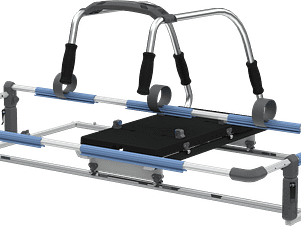
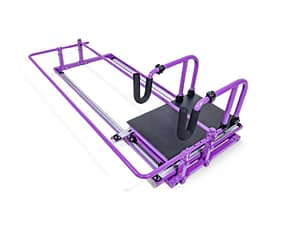
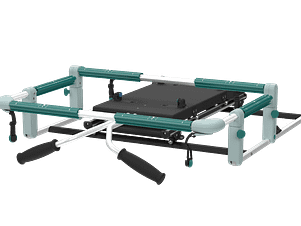
Frames such as the Grace Cutie Breeze, Grace Mini Quilter, and Janome FreeWay offer ways to move a compatible sewing machine over a quilt.
These systems are particularly interesting for quilters who already own a suitable sewing machine and want to explore frame quilting without immediately purchasing a dedicated longarm.
Depending on the frame and machine combination, you may need to reposition the quilt more or less frequently, and the available quilting area may limit the size of individual designs.
Important considerations include:
- Available table and floor space
- Machine and carriage compatibility
- Actual quilting area after the machine is installed
- How the quilt is secured and repositioned
- Access to machine controls
- Whether stitch regulation is available
The frame is only one part of the complete setup.
-
Sale!
 Compare Remove You can compare a maximum of 3 products.
Table Top Quilting Frame, Cutie Breeze for Domestic Sewing Machines by Grace
Regularly $599
Now Only $479 -
Sale!Compare Remove You can compare a maximum of 3 products.
Table Top Quilting Frame, FreeWay Frame for Domestic Sewing Machines by Handi Quilter
Regularly $1,200.95
Now Only $999.95 -
Compare Remove You can compare a maximum of 3 products.
Hoop & Zone Quilting Frames
Hoop-style frames provide another approach to working on larger quilts in a smaller space.
Instead of loading the entire quilt onto a traditional rolling frame, the quilter works on one area at a time, then repositions the fabric.
The Grace Q-Zone Hoop and Evolution Hoop are examples of this approach.
Hoop quilting can be a useful compromise between tabletop systems and full-size rolling frames, although machine compatibility, carriage requirements, and available quilting space still matter.
Full-Size Rolling Frames
A full-size frame provides a different quilting experience, particularly when paired with a purpose-built longarm.
These systems offer larger working areas and different fabric-handling capabilities, but require substantially more space.
If you’re considering a larger setup, explore our Quilting Frames and Longarm Machines shopping guides.
2. Choosing the Right Sewing Machine
One of the biggest attractions of compact frame quilting is the possibility of using a sewing machine you already own.
But not every machine is equally suited to the job.
Traditional Domestic Sewing Machines
Many domestic sewing machines can perform free-motion quilting, and some may be compatible with compact quilting frames.
Before mounting one on a frame, consider:
- Throat space and usable quilting area
- Machine weight and physical dimensions
- Free-motion quilting capability
- Needle system and available needle sizes
- Foot-control and start/stop arrangements
- Compatibility with the frame and carriage
- Availability of stitch regulation
A machine that performs beautifully during traditional free-motion quilting may require additional controls or accessories when placed on a moving frame.
High-Speed Straight-Stitch Machines
Machines such as the Janome 1600P series, Janome HD8 and HD9, and Brother PQ-series models are popular candidates for compact frame quilting.
These machines offer several appealing features, including strong straight-stitch performance, relatively generous working space, and sewing speeds that can reach approximately 1,600 stitches per minute on certain models.
They can be excellent choices for quilters who want a machine dedicated primarily to piecing, straight-stitch sewing, and quilting.
However, maximum sewing speed is only part of the equation.
A machine capable of 1,600 stitches per minute isn’t automatically capable of being moved around a quilt like a 2,500–3,000 SPM longarm.
Needle design, hook construction, machine speed, and the forces created by moving the machine all affect the quilting experience.
These machines can be effective frame-quilting tools, but operator technique is especially important.
Larger-Throat Sewing Machines With Built-In Quilting Features
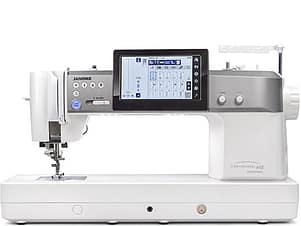
Machines such as the Janome Continental M8 and Brother CX1 represent another interesting direction.
These larger sewing machines offer substantial working space and advanced quilting features, including built-in stitch regulation when equipped with the appropriate accessories.
For quilters who want to use one machine for traditional sewing, free-motion quilting, and potentially frame quilting, these features can be particularly attractive.
A stitch-regulation sensor measures relative movement between the machine and the fabric. Whether the fabric moves beneath a stationary machine or the machine moves across stationary fabric, the principle of measuring relative movement remains the same.
However, the complete setup still matters. Machine mounting, carriage clearance, sensor placement, and access to controls should be checked before purchasing a frame.
The goal is to ensure that all components work together as a practical quilting system.
Dedicated Compact Quilting Machines
For quilters who want to move beyond a conventional domestic machine, dedicated compact quilting machines offer another option.
The Grace Little Rebel, for example, bridges traditional straight-stitch sewing and frame quilting.
Depending on the configuration, dedicated quilting machines may offer more convenient frame controls, purpose-designed quilting features, or compatible stitch-regulation arrangements.
The right choice depends on how much conventional sewing you want to do, the available space, and whether frame quilting will become your primary activity.
-
Sale!Compare Remove You can compare a maximum of 3 products.
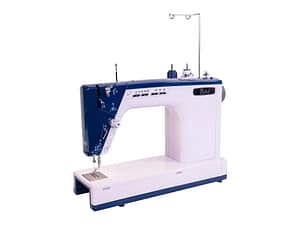
13″ Sewing & Quilting Machine with Stitch Regulation, Little Rebel by Grace
Regularly $2,699
Now Only $2,159 -
Sale!Compare Remove You can compare a maximum of 3 products.
-
Sale!Compare Remove You can compare a maximum of 3 products.

3. Understanding Machine Speed and Quilting Movement
This may be the most important lesson we can share about small-footprint frame quilting.
When quilting on a frame, the operator controls how quickly the sewing machine moves across the fabric.
The sewing machine controls how frequently the needle completes a stitch.
Those two speeds must work together.
Stitches Per Minute Isn’t the Whole Story
Imagine two quilting machines.
One can sew at 1,600 stitches per minute.
The other can sew at 3,000 stitches per minute.
At the same desired stitch length, the faster machine can theoretically accommodate more movement across the quilt.
For example, at 10 stitches per inch:
| Machine Speed | Theoretical Movement Speed |
|---|---|
| 1,600 stitches per minute | 160 inches per minute |
| 3,000 stitches per minute | 300 inches per minute |
These figures illustrate the relationship between stitch rate and movement speed. They are not recommended operating speeds or mechanical safety limits.
Even that comparison doesn’t tell the whole story.
The machines may have different needle systems, hook designs, moving components, and operating characteristics.
A purpose-built longarm is engineered for quilting in a very different environment than a domestic high-speed straight-stitch machine.
Don’t Drive a Domestic Machine Like a Longarm
A good rule for compact frame quilting is to begin with deliberate, controlled movement.
Don’t attempt to imitate the sweeping movements of an experienced longarm quilter operating a high-speed machine.
Instead:
- Begin with a moderate sewing speed.
- Practice smooth, consistent carriage movement.
- Avoid sudden changes in direction.
- Slow down for tight curves and detailed patterns.
- Pay attention to changes in machine sound and stitch formation.
- Stop immediately if the needle strikes, bends, or begins making unusual noises.
As you become comfortable with the equipment, you can develop a better understanding of its usable operating range.
There is no universal safe carriage speed that applies to every sewing machine, needle, quilt, and frame combination.
Needle Deflection and Hook Damage
Sewing machine needles are designed to penetrate fabric and form stitches in coordination with the hook.
When a machine moves sideways while the needle is engaged in the fabric, the fabric can exert lateral force on the needle.
That force may cause the needle to deflect.
Smaller domestic needles, including commonly used size 14 needles, may be more susceptible to deflection under certain conditions than heavier needles designed for different machine applications.
Excessive deflection can cause the needle to strike the hook or another component.
Depending on the circumstances, the result may be a broken needle, damaged hook, altered timing, or other mechanical problems.
This is not a theoretical concern for our repair department. We’ve repaired machines damaged during frame quilting.
That doesn’t mean a domestic sewing machine cannot be used successfully on a frame.
It means the operator needs to respect the mechanical limitations of the machine and the needle.
Quilting Technique Matters
Good frame-quilting technique involves more than keeping the stitches the same length.
Smooth movement, appropriate machine speed, correct needle selection, properly installed accessories, and avoiding abrupt carriage movements all contribute to a better experience.
Even with stitch regulation, the operator remains responsible for controlling the machine.
4. Controlling Your Machine on a Frame
This is one of the most overlooked parts of building a compact quilting system.
When a sewing machine sits on a table, its buttons and foot controller are usually within easy reach.
When the machine is mounted on a moving quilting carriage, the situation changes.
You may be standing behind the machine, holding the carriage handles, and moving the entire machine across the quilt.
How are you going to start and stop sewing?
How will you control speed?
And how will you stop the machine quickly if something goes wrong?
Foot-Control Extensions
A foot-control extension may allow the original pedal to be positioned where the operator can reach it while using the frame.
This can be a relatively straightforward solution for some machines, provided the extension is compatible with the machine and controller.
But it also means coordinating foot-pedal operation with hand movement.
Cable routing matters, too. Cords should never interfere with the carriage, frame movement, or operator.
Remote Start/Stop and Speed Controls
Some sewing machines support remote controls, handle-mounted switches, or compatible electronic speed-control accessories.
Grace offers speed-control accessories for certain sewing machines and frame combinations.
These can make operation more convenient by allowing the quilter to control sewing without reaching for the original foot pedal.
However, compatibility is machine-specific.
A remote control that works with one machine may not work with another, even if the machines look similar.
Speed Control Is Not Stitch Regulation
This distinction deserves special attention.
A speed controller determines how fast the sewing machine runs.
A stitch regulator coordinates machine speed with quilting movement to produce more consistent stitch lengths.
Those are two different jobs.
You can have convenient machine-speed control without stitch regulation.
You can also have stitch regulation that works only within a machine’s supported speed and movement range.
Understanding that difference is essential when comparing accessories.
5. Stitch Regulation: What It Does and What It Doesn’t
One of the challenges of free-motion quilting is maintaining consistent stitch length.
If the machine runs at a constant speed but the operator moves the carriage faster, the stitches become longer.
Move more slowly, and the stitches become shorter.
Stitch regulation helps coordinate those two movements.
Add-On Stitch Regulators
Systems such as AccuStitch and compatible Grace stitch-regulation accessories can provide regulation capabilities for certain machine and frame combinations.
Depending on the system, sensors monitor movement and communicate with the machine or a compatible controller to adjust sewing speed.
The exact method varies by product.
Before purchasing an add-on regulator, verify:
- Sewing machine compatibility
- Frame and carriage compatibility
- Required sensors, cables, and mounting hardware
- Supported operating modes
- Maximum machine speed and regulation limits
- Whether additional controls are required
A stitch regulator should be selected as part of the complete quilting system, not as an isolated accessory.
Built-In Stitch Regulation
Some sewing machines and dedicated quilting machines include stitch-regulation features.
The Janome Continental M8 and Brother CX1 are examples of larger domestic sewing machines offering stitch regulation with compatible accessories.
These systems can be particularly appealing because they combine conventional sewing capabilities with advanced quilting features.
When considering frame use, the important questions are how the sensor is positioned, how the machine is mounted, and whether the controls remain practical to operate.
Built-in regulation can reduce the need for a separate add-on regulator, but it doesn’t eliminate the need to verify the complete setup.
What Stitch Regulation Cannot Do
A regulator can help improve stitch consistency.
It cannot:
- Increase the sewing machine’s maximum mechanical speed
- Eliminate sideways needle forces
- Prevent every broken needle or damaged hook
- Make an incompatible machine compatible with a frame
- Compensate for unlimited carriage movement speed
Stitch regulation is a tool for better quilting, not a mechanical protection system.
-
Sale!Compare Remove You can compare a maximum of 3 products.
Stitch Regulator System for Janome HD9 Series, Elna Elnita EF1, & Other Sewing Machines by Accustitch
Regularly $1,199.00
Now Only $799.00 -
Sale!Compare Remove You can compare a maximum of 3 products.
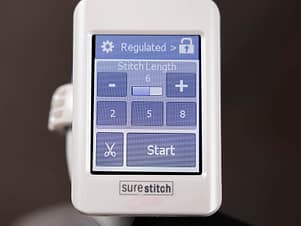
Stitch Regulator, SureStitch Elite for Compatible Sewing Machines by Grace
Regularly $999.95
Now Only $899.00

6. Building a Complete Compact Quilting System
A quilting frame is only one part of a working system.
Before buying, consider the entire setup.
The Essential Components
Frame and carriage: A compatible frame that supports the machine and provides the intended quilting area.
Sewing machine: A machine suitable for free-motion quilting and compatible with the frame.
Machine controls: A practical way to start, stop, and control sewing speed from the quilting position.
Needles and quilting supplies: Appropriate needles, thread, bobbins, and other supplies for the machine and quilt.
Workspace: A stable table or other approved support, adequate clearance, and safe power-cord routing.
Optional or Configuration-Dependent Components
Stitch regulation: A compatible built-in or add-on system for more consistent stitch length.
Handlebar controls: Remote operation for supported machines.
Frame accessories: Compatible extensions, mounting components, or other equipment needed for the intended configuration.
Lighting and workspace accessories: Additional equipment that makes quilting more comfortable.
The important thing is to identify which components are included, which are optional, and which are required for your particular machine.
7. Three Ways to Get Started
Use the Sewing Machine You Already Own
For quilters who have a compatible sewing machine and want to explore frame quilting without purchasing a dedicated longarm.
Start with a suitable compact frame, confirm carriage compatibility, and identify a safe and practical way to control the machine.
This approach can be economical, but it may involve limitations in throat space, sewing speed, and stitch regulation.
Build a High-Speed Straight-Stitch Quilting Setup
For quilters who want a machine dedicated primarily to straight-stitch sewing and quilting.
A compatible high-speed straight-stitch machine paired with a compact frame, appropriate controls, and potentially an add-on stitch regulator can create a capable small-footprint system.
Our Janome 1600P and AccuStitch demonstration is an example of the kind of configuration we’re exploring in the store.
These systems can provide a substantial step beyond basic domestic-machine quilting, but they still require controlled operation.
Choose a Purpose-Built Compact Quilting Machine
For quilters who expect to spend significant time quilting on a frame and want equipment designed with that application in mind.
Machines such as the Grace Little Rebel provide another route into compact frame quilting.
The right system may offer easier operation or features better suited to frame quilting, depending on the machine and accessories.
A larger dedicated longarm may ultimately be a better investment for someone who wants maximum quilting speed, larger working areas, or extensive automation.
8. Try It Before You Buy It
There’s no substitute for actually operating a quilting machine on a frame.
At Millard Sewing Center, we’re building hands-on demonstrations to help customers compare compact quilting systems with traditional longarm machines.
Our showroom includes Grace quilting frames and equipment, and we’re preparing a Cutie Breeze demonstration with a Janome high-speed straight-stitch machine and AccuStitch regulation.
We also have a Grace tabletop frame available for comparison.
These demonstrations help answer questions that are difficult to resolve from specifications alone:
- How much space does the setup really require?
- How does the machine feel when moved on a carriage?
- How much control do you have over sewing speed?
- What difference does stitch regulation make?
- How does a compact system compare with a dedicated longarm?
We want customers to understand both the opportunities and the compromises.
The best quilting system isn’t necessarily the fastest, largest, or most expensive. It’s the one that fits your projects, workspace, expectations, and operating style.
Let Us Help You Build the Right System
Whether you’re considering a Grace Cutie Breeze, adapting a sewing machine you already own, or exploring a dedicated quilting machine, we’re happy to help you understand the options.
We can discuss frame compatibility, machine controls, stitch regulation, and the practical considerations that make the difference between a frustrating setup and an enjoyable quilting experience.
Visit Millard Sewing Center to explore compact quilting systems and see how they compare with traditional longarm quilting.
Recommended Next Steps
Keep moving with the next guide, class, or supply category.