
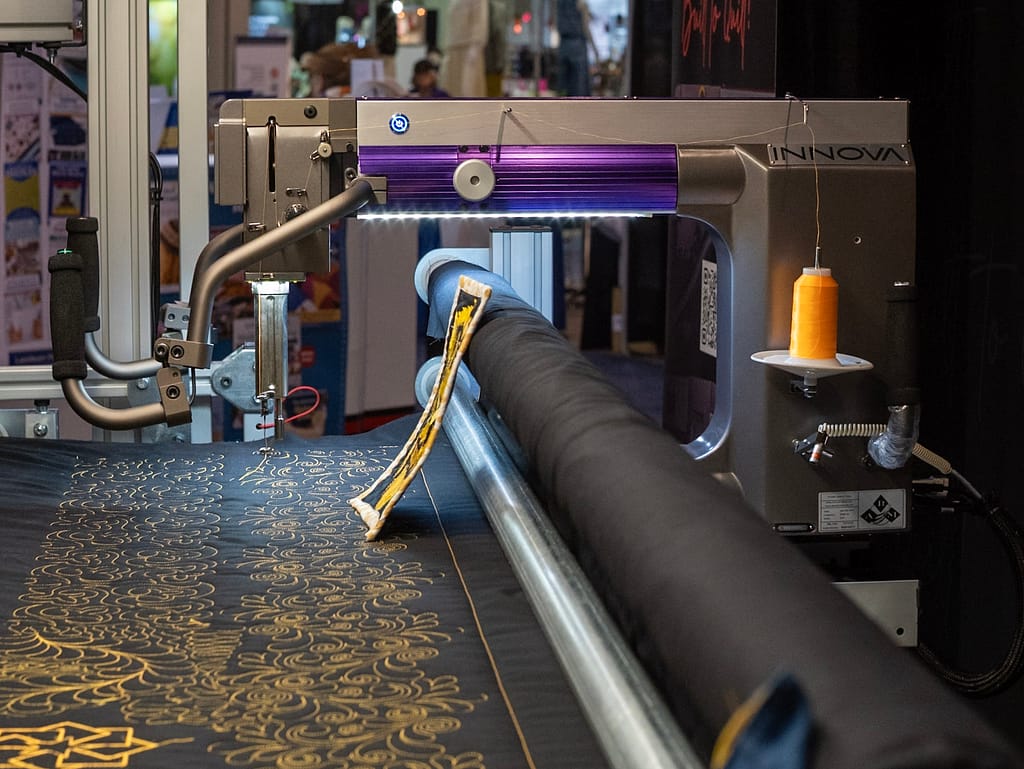
One of the most common concerns when shopping for a longarm quilting machine is whether the system will fit comfortably in your available space. The answer depends on more than just frame length. Machine size, quilting style, robotics, pantograph use, and operator access all affect the amount of room required. A machine may technically fit in a room while still feeling cramped during daily use. Planning for comfortable operation often results in a better long-term quilting experience.
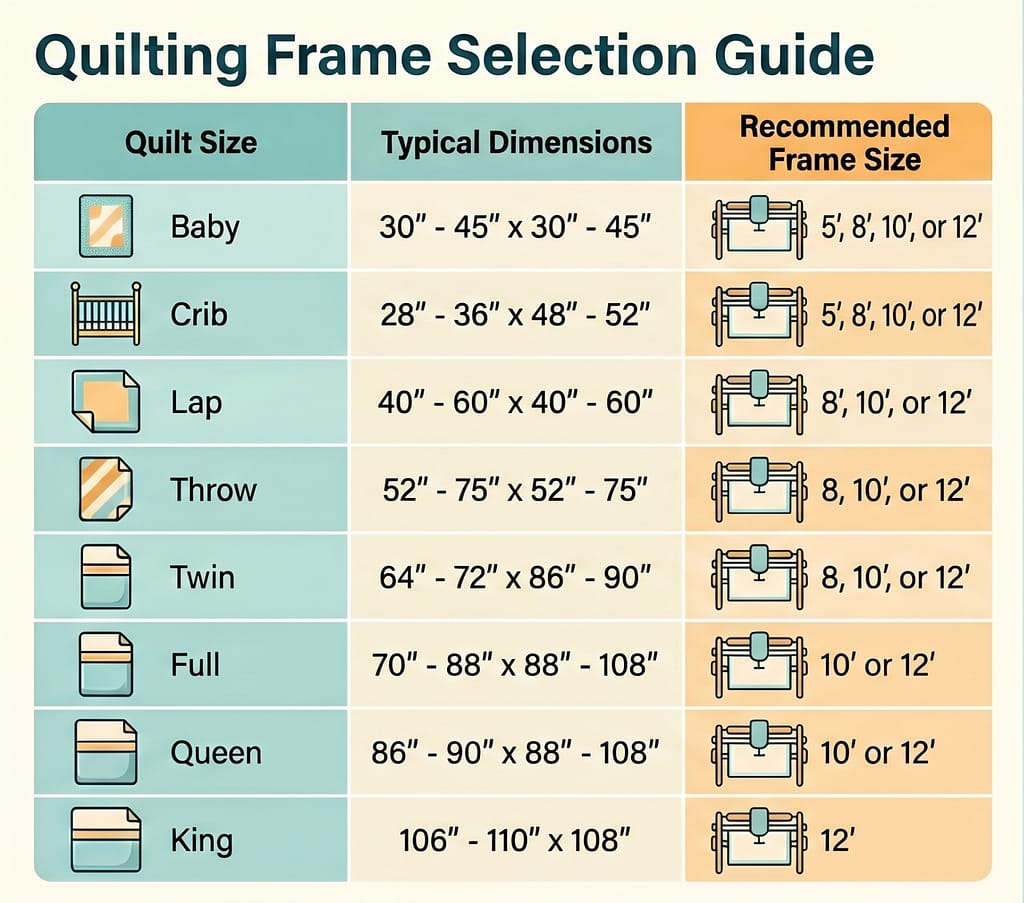
Project Size vs. Frame Size
Frame Size vs. Working Space
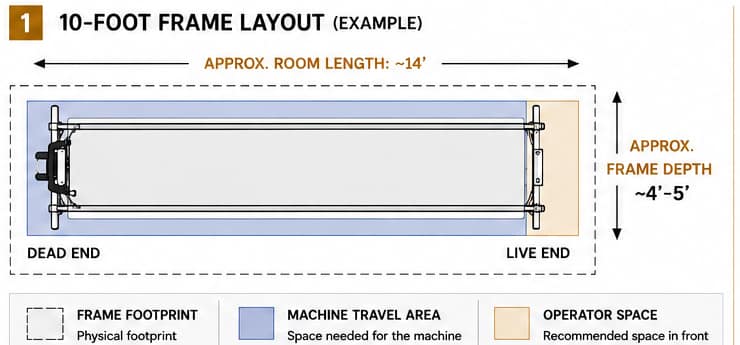
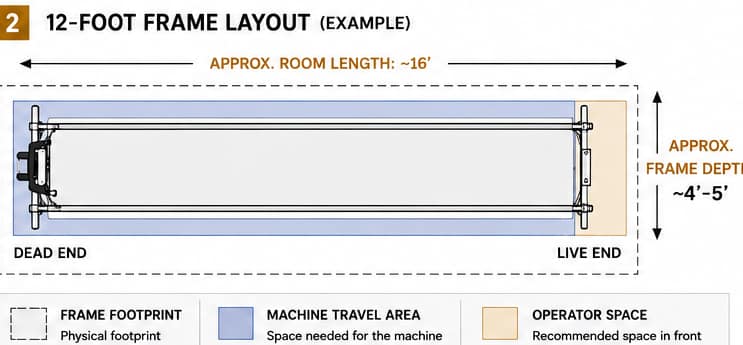
Examples shown using common 10′ and 12′ frame configurations. Actual requirements vary by machine and frame design.
- Frame length
- Frame depth
- Machine throat size
- Front operator space
- Rear access for pantographs
- Space for loading quilts
- Maintenance and service access
Frame length determines how much room is needed along the wall, but it does not tell the whole story.
A larger machine requires more front-to-back room because the machine can travel farther during quilting.
Understanding Frame Depth
Frame depth refers to the physical footprint of the frame itself.
Most modern longarm systems require approximately four to five feet of floor depth before the machine travel area and operator space are considered.
Examples
- Janome Quilt Maker Pro20 with 12′ frame: approximately 4′ frame depth
- Innova M20, M24, & M28 system: approximately 4’6″ frame depth
- Tin Lizzie 18″with Grace 12′ frame: approximately 4′ frame depth
Frame depth is only the starting point.
Understanding Operating Depth
Operating depth includes the machine’s full quilting travel and the space required for normal operation.
As throat size increases, the machine moves farther front-to-back, increasing room requirements.
Examples
- Innova M20 & M24 system: approximately 6′
- Innova M28 system: approximately 7′
- Janome QMP20 system: approximately 5.5′
- Tin Lizzie 18″ system: approximately 4.5′
These measurements help illustrate why two machines with similar frame lengths may require very different room layouts.
Throat Size and Quilting Space
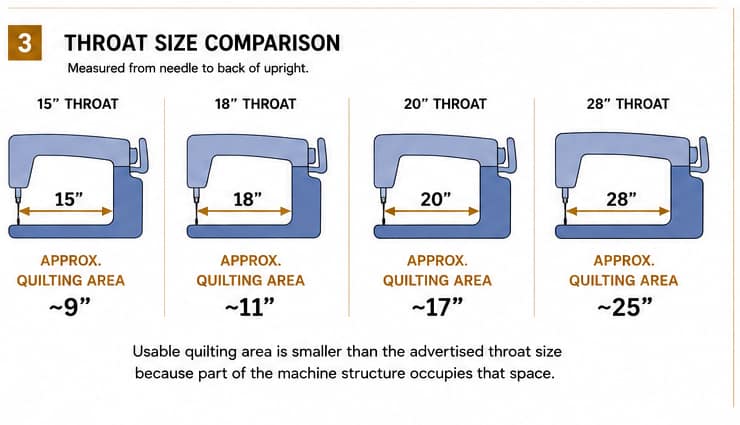
Many quilters assume that throat size directly equals usable quilting space.
In practice, the usable quilting area is smaller than the advertised throat measurement because part of the machine structure occupies that space.
| Machine | Advertised Throat | Approximate Quilting Area¹ |
|---|---|---|
| Janome 15 | 15″ | ~9″ |
| Janome 20 | 20″ | ~17″ |
| Innova M28 | 28″ | ~24″ |
¹Sizes here are measured with minimal amount of fabric and batting rolled on to take up roll. Larger and thicker quilts will reduce this number as the quilt is rolled.
Larger throat machines allow both larger continuous designs and more quilting before advancing the quilt, reducing interruptions and increasing efficiency.
Plan For Growth
Many longarm owners purchase their machine intending to quilt only for themselves.
Then they meet a lot of new friends.
Friends, family members, guild members, and fellow quilters often begin requesting quilting services once a longarm is available.
When planning your quilting room, consider not only how you quilt today but how you may want to quilt in the future.
A little extra room now can make future upgrades, robotics, customer quilting, and larger projects much easier later.
How Quilting Style Can Effect Space Requirements
The way you quilt affects the amount of space you need.
Front Operation
Free-motion quilting, ruler work, and most computerized robotic quilting systems are primarily operated from the front of the machine. Access to the rear is still needed for maintenance and possibly quilt loading however.
Pantograph Operation
Pantographs require comfortable access behind the machine. If you plan to quilt from the rear, additional room depth should be considered.
Robotics & Automation
Computerized quilting systems reduce the need for continuous operation from the rear of the machine. However, access behind the machine is still useful for maintenance, loading quilts, troubleshooting, and servicing robotics components. Some robotic systems may increase the frame footprint as well.
Comparing Longarm Frame Designs
Longarm quilting frames are available in several different construction styles. Each design has advantages and disadvantages depending on your priorities, available space, future upgrade plans, and quilting goals.
| Design | Strength | Tradeoff |
| Precision Machined | Maximum alignment and rigidity | Multiple pieces, more involved installation |
| Welded Steel | Durability and stability | Fixed dimensions, welding distortion, limited repair options |
| Modular Bolt-Together | Shipping and expansion flexibility | More joints and potential flex |
| Wooden | Simplicity and lower cost | Less rigidity and support |
Precision Machined Frames
Precision machined frames use accurately manufactured components that are machined to tight tolerances before assembly. Similar construction methods are commonly found in industrial equipment, laboratory machinery, and precision manufacturing systems.
Advantages:
- Exceptional alignment and precision
- Extremely rigid construction
- Minimal flex during quilting
- Excellent stitch consistency across large projects
- Individual components can often be serviced or replaced
Considerations:
- More involved installation
- Larger components may require on-site
- Typically higher initial cost
- Professional assembly strongly encouraged
Quilters looking for maximum precision, rigidity, and long-term performance often prefer this style of frame construction.
Welded Steel Frames
Welded frames use permanently joined (usually steel) components to create a strong, durable structure.
Advantages:
- Strong construction
- Fewer individual components
- Simple overall design
- Good long-term durability
- Excessive steel mass can mask machine vibrations from lower quality machines.
Considerations:
- Frame dimensions are generally fixed
- Limited adjustment after manufacturing
- Large fixed pieces may be harder to maneuver into place inside a home
- Repairs are more difficult and require more to be replaced if damage or wear occurs
- Welded assemblies can introduce small manufacturing distortions that cannot be adjusted later
- Weight
Many welded-frame systems provide years of reliable service and are commonly found on both hobby and commercial quilting machines.
Modular Bolt-Together Frames
Modular frames use individual frame sections connected together during assembly. Many modern home quilting systems use this approach because it simplifies shipping and allows future expansion.
Advantages:
- Ships in smaller pieces
- Easier to move into basements and finished quilting rooms
- Can often be shortened or lengthened later with minimal purchase
- Easier to transport when relocating
- Individual sections are easier to replace if damaged
Considerations:
- More joints and connection points
- Less rigid than comparable machined-frame systems
- Additional assembly required
- Frame stiffness depends heavily on design and assembly quality
For many home quilters, modular frames offer an excellent balance of flexibility, shipping convenience, and performance.
Wooden Frames
Wooden quilting frames were common on many earlier longarm systems and remain in use today.
Advantages:
- Often lower cost
- Relatively easy to modify or repair
- Can provide decades of service when properly maintained
Considerations:
- Sensitive to humidity and environmental changes
- Generally less rigid than modern metal frames
- May require more frequent adjustment
- Replacement parts can be difficult to source for older systems
Many quilters continue to produce beautiful work on wooden frames, though most modern longarm systems now use steel or aluminum construction.
Which Frame Design Is Best?
There is no single frame design that is right for every quilter.
If maximum rigidity and precision are the primary goals, machined-frame systems are often considered the benchmark.
If future flexibility, easier shipping, and the ability to change frame lengths are important, modular bolt-together systems can be an excellent choice.
The best frame is ultimately the one that fits your quilting goals, available space, budget, and long-term plans.
Still Not Sure Which Longarm Is Right For You?
Every quilting space, quilting style, and budget is different.
Over the years, we’ve helped quilters set up longarm machines in spare bedrooms, finished basements, dedicated quilting studios, and commercial quilting businesses. We’ve seen what works well, what people wish they had planned differently, and how quilting needs often change over time.
One of the biggest advantages of working with an experienced longarm dealer is that we’ve seen hundreds of quilting room layouts and worked with a wide variety of longarm systems. We can often identify space concerns, workflow issues, or upgrade opportunities before they become expensive mistakes.
Whether you’re comparing frame sizes, considering robotics, planning a future quilting business, or simply trying to determine what will fit comfortably in your available space, we’re happy to share what we’ve learned.
We can help you compare:
- Room and space requirements
- Frame sizes and frame designs
- Innova and Janome longarm systems
- Robotics and automation options
- Delivery, setup, and training
- Future expansion and upgrade paths
Have questions about your quilting room or longarm plans? Contact Millard Sewing Center and we’ll be happy to help.
Recommended Next Steps
Keep moving with the next guide, class, or supply category.