
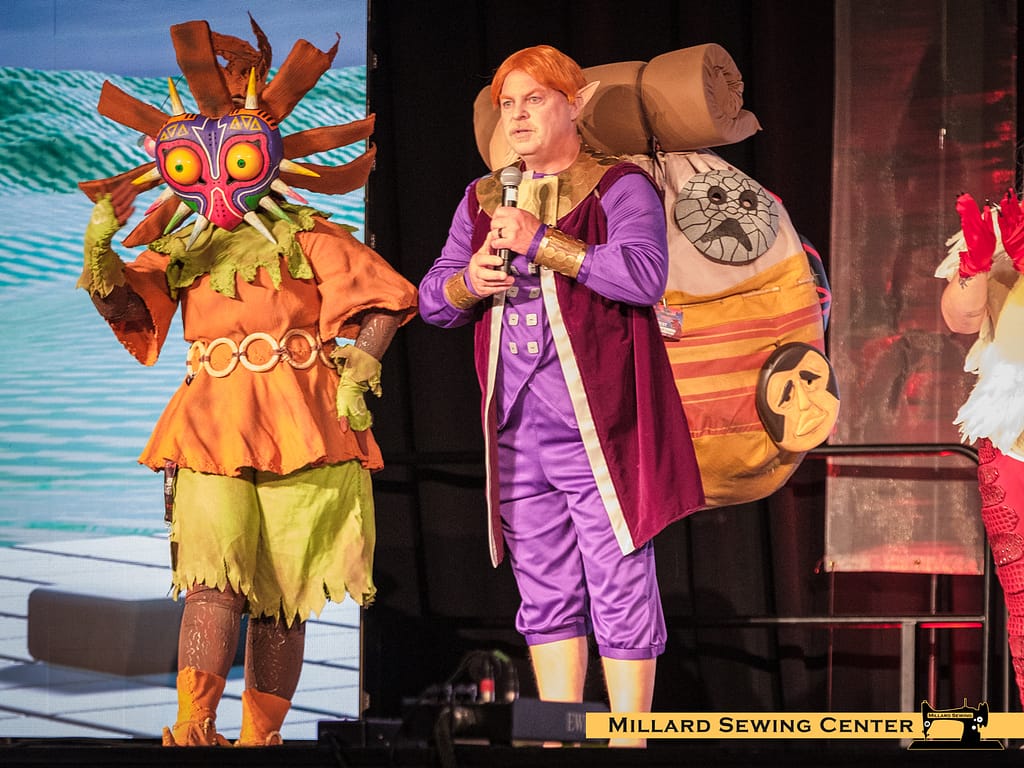
A guide on how to interpret designs and problem solve fictional designs to make a recognizable cosplay.
When designing or creating cosplays of characters from fictional media, it can be incredibly difficult to understand what path to take or how to solve certain problems. This is a simple guide to some basic problems and solutions to what roadblocks many cosplayers face.
Before diving head first and stressing about recreating historical techniques or sewing thousands of beads, think about what success means for your particular costume. If its a competition cosplay, it may require accuracy, craftsmanship, proper construction, details, ambitious techniques at the sacrifice of expense, time, fragility, or comfort. However, for a non-competition cosplay, wearability, vision, and comfort can take priority while walking the convention. Costumes created for the fun of cosplay can include however much or little detail as you’d like.
Finding Reference Images
The best reference images include character sheets, official 3-D models, and official images and merchandise. These provide official designs and are usually high-quality images. For other references to consider, anime figures and official collaborations can be a way to see the character in different poses and media.
A good reference image should be an official design of the character, in a simple pose, in good picture quality. The more detail you can find in your references, the easier it will be to translate the design into a real costume. Avoid using images of the character that are low quality or of a different design. For some characters, their design may differ between games, seasons, or episodes.
If you can’t find references of the character straight on, other cosplayers and costumes for sale can be useful. Oftentimes, they’ve already solved the problem of finding fabrics, creating shapes, and filling out the rest of the cosplay. It can be useful for seeing how someone else solved a construction problem, but remember that their costume is their interpretation rather than an official reference.
If you’re truly struggling with getting ahold of reference images, the best alternate option is simply creativity. Decide yourself based on the character’s personality, world, and archetype. Cosplay is about the love for a character, not always having the exact same outfit and every detail identical to your reference.
When to Go By the Book
The first goal most cosplayers have is to make sure their cosplay looks just like the character. In reality, there are multiple reasons to depart from the original character design.
Some characters have incredible detail, intricate designs, or baffling shapes. When facing difficult parts, consider simplifying details, or creating the detail in different ways. If a pattern is too difficult to hand paint or hand bead, consider alternatives such as machine embroidery. If a shape is too extreme, simplify it to something more achievable and comfortable.
Even if you’re limited on budget, materials, or inspiration, these can be challenges that make you consider thinking outside the box. Save money by using fabrics you already own. By considering the feeling and design of the character, you can mix different textures and colors to add depth to your cosplay.
It’s not uncommon to see cosplays that don’t match the character to a tee. Many cosplayers create mash-up cosplays, or change the design into renaissance or futuristic styles. These are more common than one would think, and showcase how cosplay is ultimately about a love for the character or source material.
Have an idea? Try it! Experiment with different fabrics, techniques, and textures to make your cosplay unique.
Identifying Fabrics and Materials
There are multiple ways to interpret fabric and materials when looking at drawings or models. The first thing to consider is the function. Does the fabric stretch, drape, or hold structure in a specific way? Make sure your fabric choices match the required function of the cosplay itself. If you can’t move or breathe in the fabric, it’s likely the wrong choice for you to make.
The pattern and design of the fabric can often be up to personal choice. When picking fabrics, consider the time period, location, and feelings of the character. Consider Princess Peach, a character whose design is relatively simple. Many cosplayers choose intricate patterns, stylized silhouettes, and details such as gems and lace to capture her royal status.
Materials such as grommets, buckles, boning, and more may be required for your cosplay. Consider how a garment needs to be put on, and how it needs to hold structure. For lightweight fabrics or accessories, snaps or hooks and eyes may provide enough support. Heavier or more structured pieces may require buckles, grommets, or zippers.
Creating Structure
Some characters have strange shapes, impossible proportions, or gravity defying pieces. There are multiple strategies to get certain looks using patternmaking, structural materials, fabric, and structural undergarments.
Patternmaking can be one of the first steps to help get dramatic or specific shapes. Consider altering patterns, or using a dress form to drape fabric when trying to get a challenging shape or result. Once again, making a muslin mock up and noting the changes you’ve made to a pattern and the measurements you used can be a big help in recreating certain effects in the future.
Wire, boning, and horsehair braid are some of the go-to materials many cosplayers use for creating volume, shapes, corsets, accessories, and more. These are stiffer materials that you can attach to hems or feed through tubes throughout your cosplay.
Fabric choices can have a big impact on the final shape that your cosplay conveys. Denim, canvas, and faux leather are iconic as stiffer materials that keep their shape best. Knits and other stretchy materials can conform closely to the body, best for colored bodysuits or form fitting suits. Consider the amount of support, stretch, or drape you require for your garment before selecting the first fabric that looks right.
Dramatic or cartoony proportions can often be solved by garments underneath such as corsets, petticoats, bustles, and general padding. These garments have been used for hundreds of years, and continue to be used for many types of dresses and cosplays to this day.
Attaching Layers and Props
Many characters have multiple layers, belts, or elements that may not have a clear attachment point. Depending on the intended result, there are multiple ways to attach certain items.
The most obvious suggestion is to stitch it on. For layered skirts or ruffles, consider where the fabric may attach or where to hide stitching. Handsewing can be useful in many cases for efficiently hiding seams. However, if it is a heavy piece or can be easily pulled such as a cloak or cape, machine sew with quality thread to ensure it holds.
Fasteners such as buttons, snaps, hooks and eyes, velcro, and zippers are options as well. Separating zippers are the same you’ll find on zip up hoodies or coats with removable hoods, which can be great for wanting multiple points of contact with the ability to fully remove the item. Snaps, velcro, hooks and eyes, and buttons allow specific contact points, perfect for small accessories.
Magnets are an extremely versatile option. There are multiple types of magnets, some made to be sewn in, and some that can be glued into props. Because of the array of sizes and strengths, they can be useful for quickly removing parts, costume changes, transporting, storing, or adding accessibility.
Understand your goal and research which fastener will work best to attach your layers and props. There’s not only one way to interpret a character.
Final Result Feels Incomplete
If your finished result feels like it’s missing something, there are many ways to connect your cosplay and garment to the character.
Weathering and distressing add depth and emotion to many cosplays. If the character your cosplay is of comes from combat, nature, injury, etc., try adding tears, fake burns, or discoloration to your cosplay. Decide if this is right for your cosplay before applying dye or paint to your finished cosplay.
Add layers to your cosplay. Many characters may appear simple on the outside, but shaping and layering the costume can add the detail necessary to make your character feel real. Add a petticoat under your skirt, wear a corset, add tights, or add an undershirt for more dimension and texture to your cosplay.
Embellishments or additional designs can be added to elevate your cosplay. Lace, beads, and embroidery can be added later in the construction process. Even simpler, iron on patches and iron on vinyl can be added in seconds and improve the final result of your cosplay. Remember to consider the world and personality of your character.
Props can make a character more recognizable while also helping communicate their world, role, or abilities. What would a mage or wizard character be without their staff? Adding a prop or accessory onto your cosplay can show where the character comes from and what skills they have, making your cosplay exciting to see even for people who don’t recognize the character.
Full on Stuck?
If you truly feel like you can’t get anywhere, here are your next steps.
Take a Break
If you haven’t stepped away, take a break from your project. Ideas and solutions can come best when not under stress or pressure. Try watching, reading, or listening to the media the character is from to regain some energy and motivation.
Get a second opinion
Bring in a friend or family member who may have sewing experience. Even if they don’t, explaining your current problem aloud can make it easier to realize what you may have forgotten or need to do next.
Return to your Reference
Take a second to look back at your character. Having a printed reference makes it easiest to review what your goal is. Referencing patterns or other cosplayers can also be a large help in getting back on track with what step is next on your cosplay.
See Your Progress
Sometimes, seeing your cosplay on a mannequin or laid out on the floor simply doesn’t do it justice. Take another look when you’ve tried on what is currently finished. That can set your roadmap for another part to work on or how to improve something.
Cosplay Consultation
Consider booking a class with our Cosplay consultation. Our one on one classes and consultations are perfect for helping you get out of a rut and understand what the next step is and how to accomplish it.
Related Resources
Helpful pages to keep learning.