
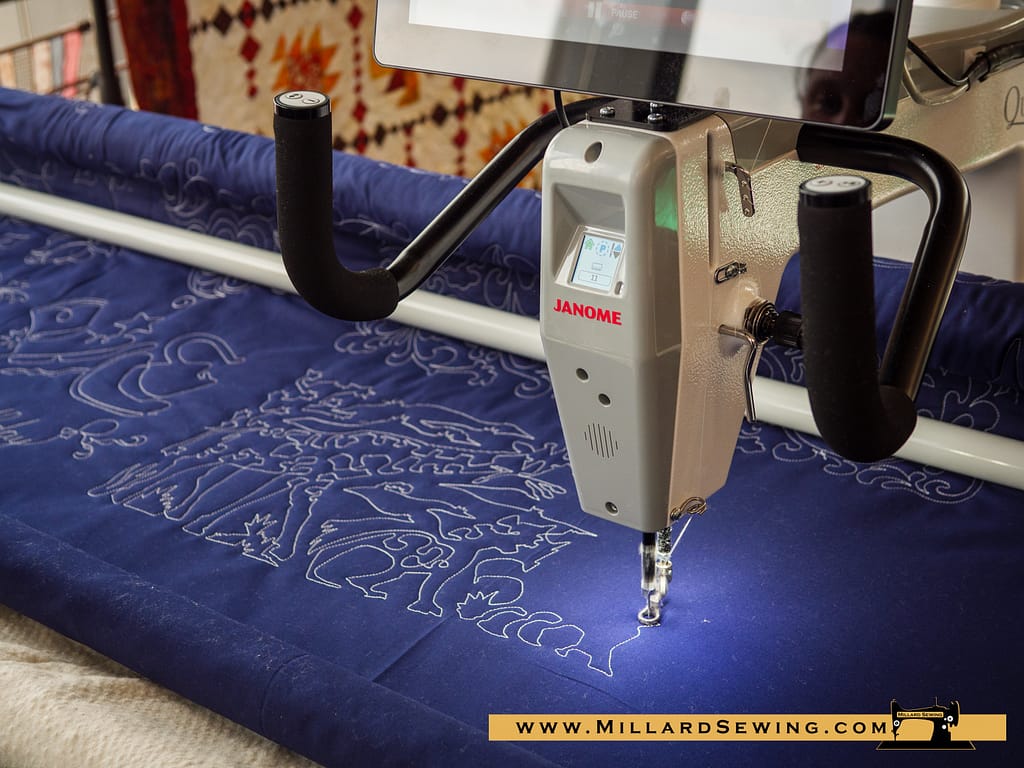
Longarm problems can feel intimidating, but many stitch issues come back to a few common areas: threading, needles, bobbins, tension, lint, hook condition, stitch regulation, or movement speed. The key is to diagnose the symptom before adjusting everything. A skipped stitch, a long stitch, and a tension problem may look similar at first, but they usually point to different causes.
Start Here Before Adjusting Everything
- Replace the needle.
- Confirm the needle is the correct system for your machine.
- Make sure the needle is installed correctly, with the scarf facing the correct direction for your machine.
- Re-thread the machine from the beginning using the manufacturer’s thread path.
- Clean lint from the hook, race, bobbin case area, and needle plate area.
- Check that the bobbin is wound evenly and inserted correctly.
- Test with a known good thread.
Make one change at a time, then test again.
Changing several things at once can make troubleshooting harder. Start with the simple checks, test, and then move deeper only if the problem continues.
Skipped Stitch vs. Long Stitch
Before troubleshooting, determine whether the needle actually entered the fabric.
Skipped Stitch
A skipped stitch happens when the needle penetrates the fabric and leaves a hole, but the stitch does not form because the top thread loop was not caught by the hook.
Visual cue: visible needle holes where stitches should have formed.
Long or Missed Stitch
A long stitch happens when the machine travels farther than expected before the next stitch forms. In this case, the needle may not have entered the fabric during the gap.
Visual cue: no needle holes in the gap between stitches.
Common Causes Of Skipped Stitches
- Incorrect thread routing: double-check the manufacturer’s thread path and re-thread from the beginning.
- Thread issue: test with a known good thread and check for shredding, twisting, or thread path snags.
- Needle issue: replace the needle. A dull, bent, incorrect, or incorrectly installed needle can cause skipped stitches.
- Wrong needle system: longarm machines require the correct needle system. A needle that looks close may still be wrong.
- Needle orientation: verify the scarf and groove are facing the correct direction for your machine.
- Hook timing: the hook point must pass behind the needle at the correct moment on the needle’s upstroke.
- Hook clearance: the hook should pass very close to the needle without colliding with it.
- Hook damage: needle strikes, rough spots, chips, or a broken hook point can prevent clean stitch formation.
The hook point should be sharp enough to slip behind the thread loop, but smooth enough that it does not snag the thread. Think of wearing your favorite sweater with a chipped or cracked fingernail. That same “snag logic” applies to thread and the hook.
Minor hook damage can sometimes be polished out. Deeper scars, rough edges, or a broken hook tip may require hook replacement.
Common Causes Of Long Stitches
Long stitches are usually related to movement speed, stitch regulation, or encoder feedback.
Manual Mode:
The machine runs at a constant speed and is not stitch regulated.
- Speed mismatch: moving the machine faster than the motor speed can make stitches longer than expected.
- Machine speed too low: slow your movement or increase machine speed to better match your quilting movement.
Stitch Regulated:
The machine speeds up and slows down with operator movement.
- Dirty encoder wheels: clean the encoder wheels and the track where they run.
- Poor encoder contact: make sure encoder wheels are touching the track consistently. If the machine moves, the encoder wheel should move too.
- Loose or damaged encoder cables: inspect cables and connections.
- Encoder failure: if possible, swap components between the X and Y axis to help isolate whether the cable, encoder, or machine is causing the problem.
When troubleshooting encoders, start with the simplest checks: clean the wheels and track, confirm contact, and inspect the cable. If the problem follows a cable or encoder when swapped between axes, that part is likely the problem. If the issue does not follow the cable or encoder, the problem may be inside the machine or control system.
Thread Tension Problems
Troubleshooting longarm thread tension requires a systematic approach. Start with maintenance, then the bobbin, then the top tension.
Initial Maintenance Checks
Before turning knobs or screws, make sure basic maintenance is up to date. Maintenance is important on any sewing machine, but it is especially important on high-speed longarm machines.
- Clean and oil: remove the bobbin case and needle plate. Brush lint from the hook race area and oil according to the manufacturer’s instructions.
- Change the needle: an incorrect, dull, or slightly bent needle can mimic tension problems.
- Check the bobbin: make sure it is the correct style, not damaged, not overfilled, wound evenly, and inserted in the correct direction.
- Check the bobbin case: confirm the bobbin sits correctly in the case and that the bobbin does not drag on the edge.
- Inspect the hook: chips, burrs, needle strikes, or rough spots can grab the thread and appear as tension problems.
- Re-thread completely: use a known good thread and follow the manufacturer’s thread path.
A damaged hook can cause the thread to release at the wrong time or fail to release smoothly. This can look like a tension issue even when the actual problem is mechanical.
Set The Bobbin Tension First
The bobbin is the foundation of the stitch. Before adjusting the top thread, make sure the bobbin case tension is consistent.
- Pull several inches of thread from the bobbin case. It should feel smooth and consistent.
- If the pull feels jerky, rough, or inconsistent, clean the bobbin case and try a freshly wound bobbin.
- If the bobbin case has been dropped, bent, or damaged, it may no longer hold consistent tension.
- A Towa-style bobbin tension gauge can help set a repeatable numerical value.
- If adjusting manually, use very small turns. A little movement on the bobbin screw can make a big difference.
Balance With Top Tension
Once the bobbin tension is consistent, adjust the top tension to pull the stitch knot into the center of the quilt batting.
- Loops or eyelashes on the bottom: tighten the top tension.
- Bobbin thread pulled to the top: loosen the top tension.
- Inconsistent tension: re-check threading, tension discs, pretensioner, check spring, needle, bobbin, hook condition, and thread quality.
Many longarm machines have both a main tension assembly and a pretensioner. Both can affect the final stitch.
If your machine uses traditional tension discs, make sure the discs are clean and the thread is seated between them. If your machine uses a rotary-style tension assembly, such as some Innova M Series machines, follow the manufacturer’s wrapping instructions carefully.
The check spring or slack thread regulator is also important. It helps keep the thread controlled between the tension assembly and needle while the stitch forms. If the spring is not moving freely or is out of adjustment, tension can become inconsistent.
Diagnostic Stitch Testing
Always test on a scrap quilt sandwich attached to the side of the frame before returning to the actual quilt.
- Use similar materials: test with the same thread, batting, and fabric type when possible.
- Use contrasting thread colors: contrasting top and bobbin colors make it easier to see which thread is being pulled to the wrong side.
- Test circles and turns: circles, curves, and sharp turns reveal direction-based tension problems that will not show in straight lines.
- Use the fingernail test: run your fingernail over the stitching on both sides. It should glide smoothly. If it catches or feels like a spiral notebook, the tension is not balanced.
- Change one thing at a time: adjust, test, then adjust again only if needed.
Changing thread weight, thread type, batting, or fabric after setting tension may require additional adjustments.
When It May Need Service
Some longarm problems can be corrected with cleaning, threading, needles, bobbins, and normal adjustments. Others may require service.
- Hook timing is out of specification.
- Hook clearance is incorrect.
- The hook has deep needle strike damage.
- The hook tip is broken or rough.
- Encoders or encoder cables have failed.
- The machine does not respond correctly in regulated mode.
- Skipped stitches continue after replacing the needle, re-threading, and checking the hook area.
- Tension remains inconsistent after cleaning, re-threading, needle replacement, and bobbin checks.
If the hook and needle collide, damage can occur quickly. When in doubt, stop and have the machine inspected before continuing to sew.
Good Habits Prevent Problems
- Change needles regularly.
- Clean lint from the bobbin and hook area often.
- Oil according to the manufacturer’s instructions.
- Use quality thread that works well with your machine.
- Keep bobbins clean, smooth, and evenly wound.
- Test tension before starting important quilts.
- Do not force the machine if something feels wrong.
- Keep encoder wheels and tracks clean.
- Track what changed when a problem starts: needle, thread, bobbin, batting, fabric, speed, cleaning, or threading.
Recommended Next Steps
Keep moving with the next guide, class, or supply category.